Although we need to earn a living, there are sometimes opportunities that arise that will either help exercise our brains or they’ll be a bit of fun, but which aren’t about raising an invoice. One such opportunity was NLA’s Reimagine London competition which we entered a few months ago. Sadly, our project didn’t make the shortlist, but we still think there is a story to be told and indeed, a wider conversation to be had about how we manage transport assets as they age. This post showcases our idea which was to reimagine the Rotherhithe Tunnel.
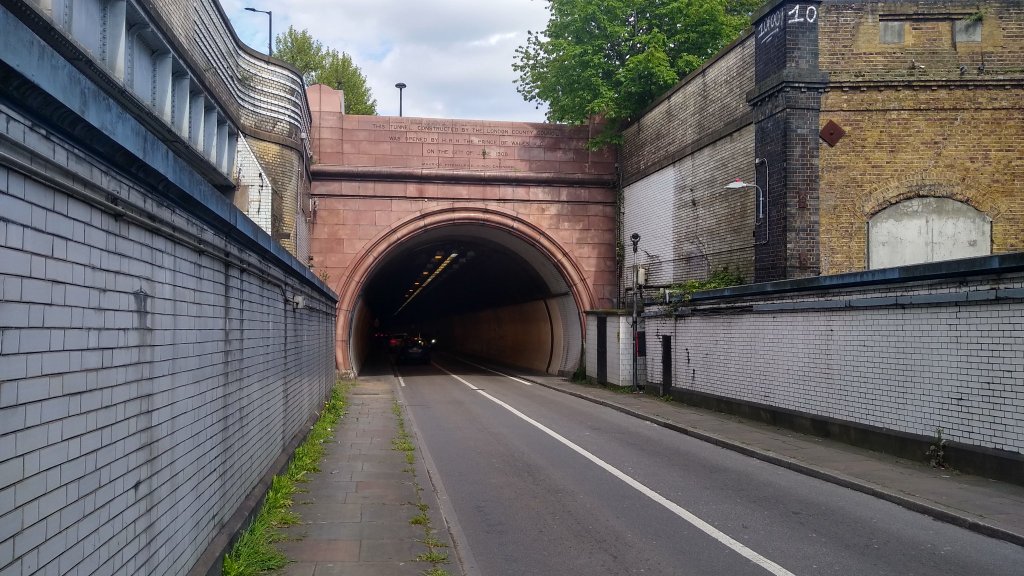
There was an early plan to build a crossing of the Thames at Rotherhithe for pedestrians, cattle and carriages at the start of the 19th century, but despite having legislative backing, it never got off the ground and it wasn’t until a century later that the London County Council successfully delivered the tunnel we see today.
The tunnel opened in 1908 and was used by some 14,000 pedestrians and 2,600 vehicles a day (mostly horse drawn), but in common with many roads and streets in London, the growth of motorisation soon chased people away leaving motor traffic dominate the space. There have been periods where bus services were operated, but the last Transport for London operated service ended in 2006.
Motor traffic peaked at around 37,500 vehicles per day in 2003, reducing to just under 28,000 vehicles per day by 2022; traffic flows which mean that those travelling through under their own power really are the fit and brave with just 147 people cycling through the tunnel each day and walking essentially for those visiting for adventure and novelty.
As the tunnel moves from modernity to heritage, it will become increasingly difficult to manage and maintain for its present use, especially where it was never designed for that use. Over the years, restrictions on the traffic using the tunnel have increased and now 2 metre width, 2 metre height and 2 tonnes restrictions are in place to mitigate the capabilities of the tunnel’s ageing ventilation and fire control systems which are only really needed because of motor traffic.
We think it is time to have a conversation about the future of the Rotherhithe Tunnel and to reimagine its use for the 21st century. The area to the east of Tower Bridge is far less served for walking, wheeling and cycling than the central and western reaches of the Thames (and is itself quite hostile for cycling). The controversial Silvertown Tunnel makes no provision for walking, wheeling and cycling beyond using buses and it connects to motorway-style roads that nobody will enjoy being near anyway.
The Rotherhithe Tunnel approach ramps have gradients gentle enough for walking, wheeling and cycling and given the original levels of walking, the removal of motor traffic could make that conducive again. However, it is from the strategic cycling point of view where we can see the greatest potential, as the tunnel could perfectly connect three of London’s strategic Cycleways with very little work.
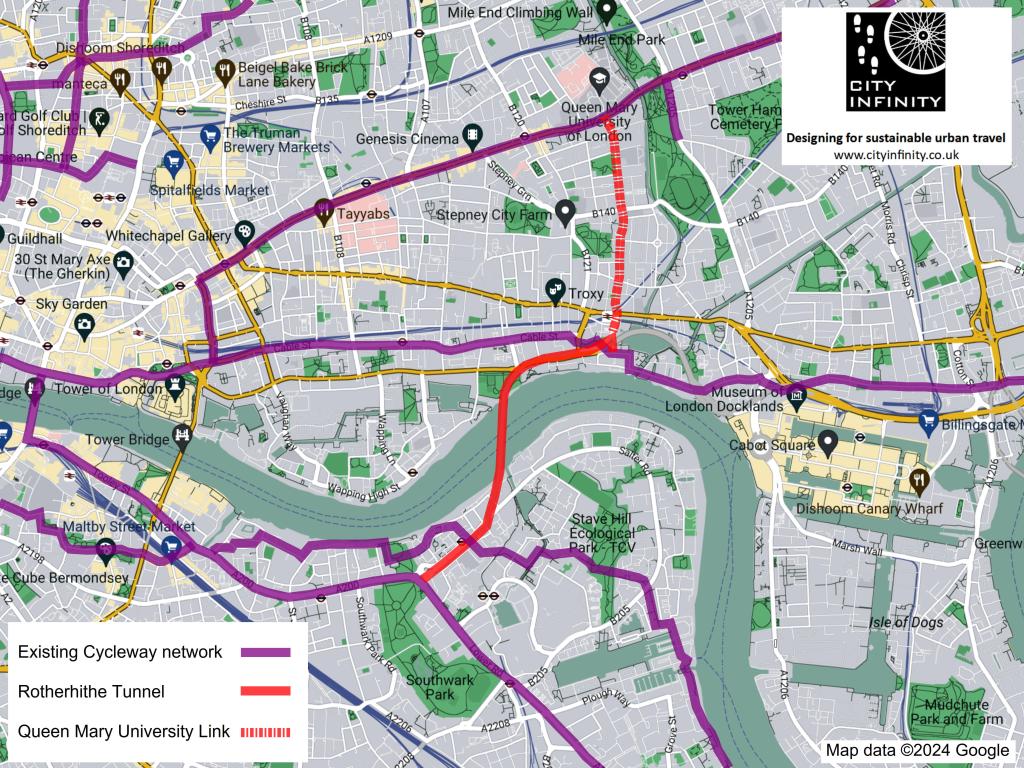
To the south, Cycleway 4 would plug right into the tunnel, removing the need for the roundabout at the Jamaica Road/ tunnel/ Lower Road junction leaving a huge area to be reclaimed for open space for people. To the north, the redesign of the 200 metre long Branch Road would connect the tunnel to Cycleway 3 and a cycle route to the Transport for London Cycleway standard could very easily continue for 1.2 kilometres north to Cycleway 2 at Queen Mary University.
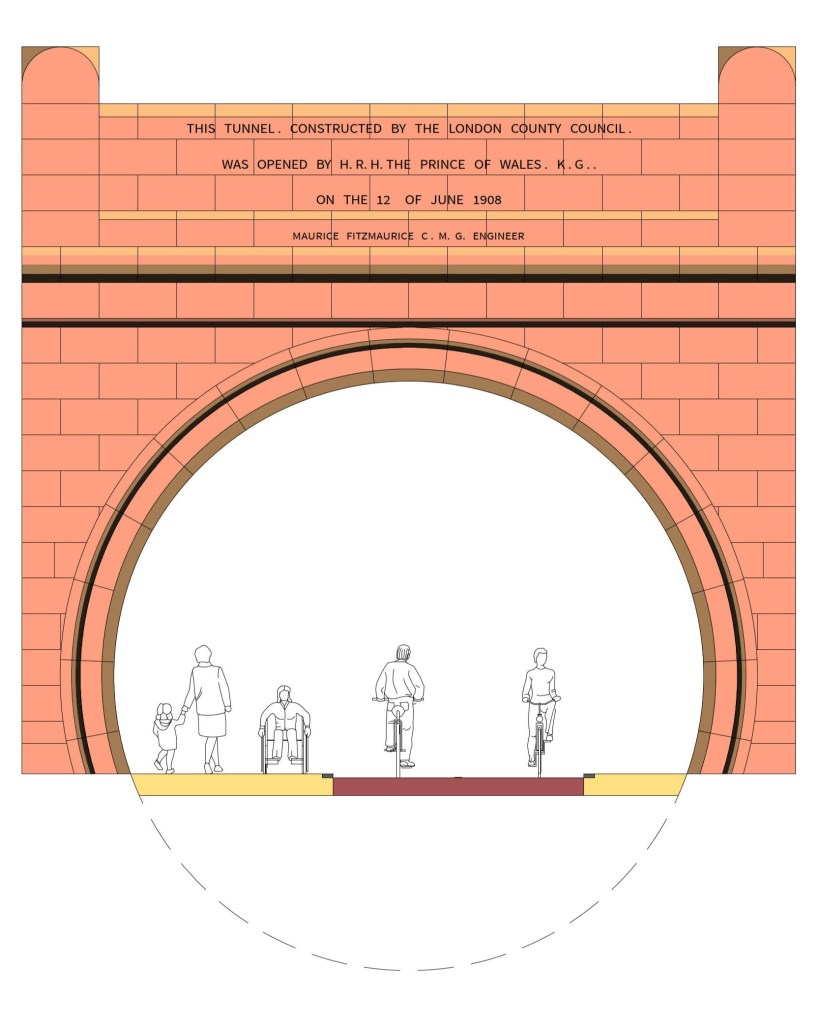
Given the efficiency of space cycling provides, only part of the carriageway would be needed for a two-way cycle track which means one of the existing narrow footways could be significantly widened and with some care, controlled emergency vehicle access could be permitted in the most serious cases. With the rise of electrically assisted cargo-cycles, a whole new part of London could be opened up for low-impact logics.
A reimagined Rotherhithe Tunnel would provide East Londoners with more local transport choices, it would reconnect neighbourhoods across the Thames for people-scale movement and it would sustainably secure the tunnel in the longer term.
We imagine streets, neighbourhoods, towns and cities where walking, wheeling and cycling are the safest, easiest and most natural choices for local trips. We design for sustainable mobility and can help you to create better places – take a look at our website for the services we offer.
 City Infinity
wow!! 77Reimagine Rotherhithe
LikeLike
A small city in Norway can do it so why can’t London https://youtu.be/JCedclz03uI?feature=shared
LikeLike
That’s amazing and the geology under the Thames is a doddle in comparison (and we’ve been criss-crossing the Thames for 200 years!)
LikeLike
Coming back from the 2023 Dunwich Dynamo, the coach tried to use the Rotherhithe tunnel – it was crazy (negligent?) that the coach driver wasn’t using high vehicle specific GPS.
LikeLike