We’re hoping to blow your minds a little with this post and as you read through, the little voice in your brain is the cognitive dissonance of motonormativity pulling at your synapses. Moto-what-now? Motonormitivity – an unconscious cognitive bias in which the assumption is made that motor car ownership and use is an unremarkable social norm. A term coined by Walker, Tapp and Davis in 2023 which doesn’t just affect drivers as you might expect, but also non-drivers given the all-pervading encroachment of motor vehicles into public space, consciousness and culture. Before you read on, you might want to listen to Ian Walker talking about the subject on The War on Cars podcast.
Although the motor car was a late nineteenth century invention, it only started to become prevalent in the 1920s as it moved from the realms of wealthy hobbyists to becoming something more people could aspire to, and indeed afford. Gradually, the UK started to react to motorisation of its streets with legislation such as the Road Traffic Act 1930 which was a wider push to regulate motor traffic and which contains very familiar ideas such manging where traffic can go and a whole suite of driving offences; although if you happened to be driving a vehicle not carrying more than seven passengers and you had pneumatic tyres, there was no speed limit!
There was also the The Traffic Signs (Size, Colour and Type) Provisional Regulations, 1933 which was a go at trying to standardise traffic signs. The Road Traffic Act 1934 then introduced the default urban 30mph speed limit that arrived in 1935 and also paved the way for the ubiquitous Belisha Beacon, named after the transport minister.
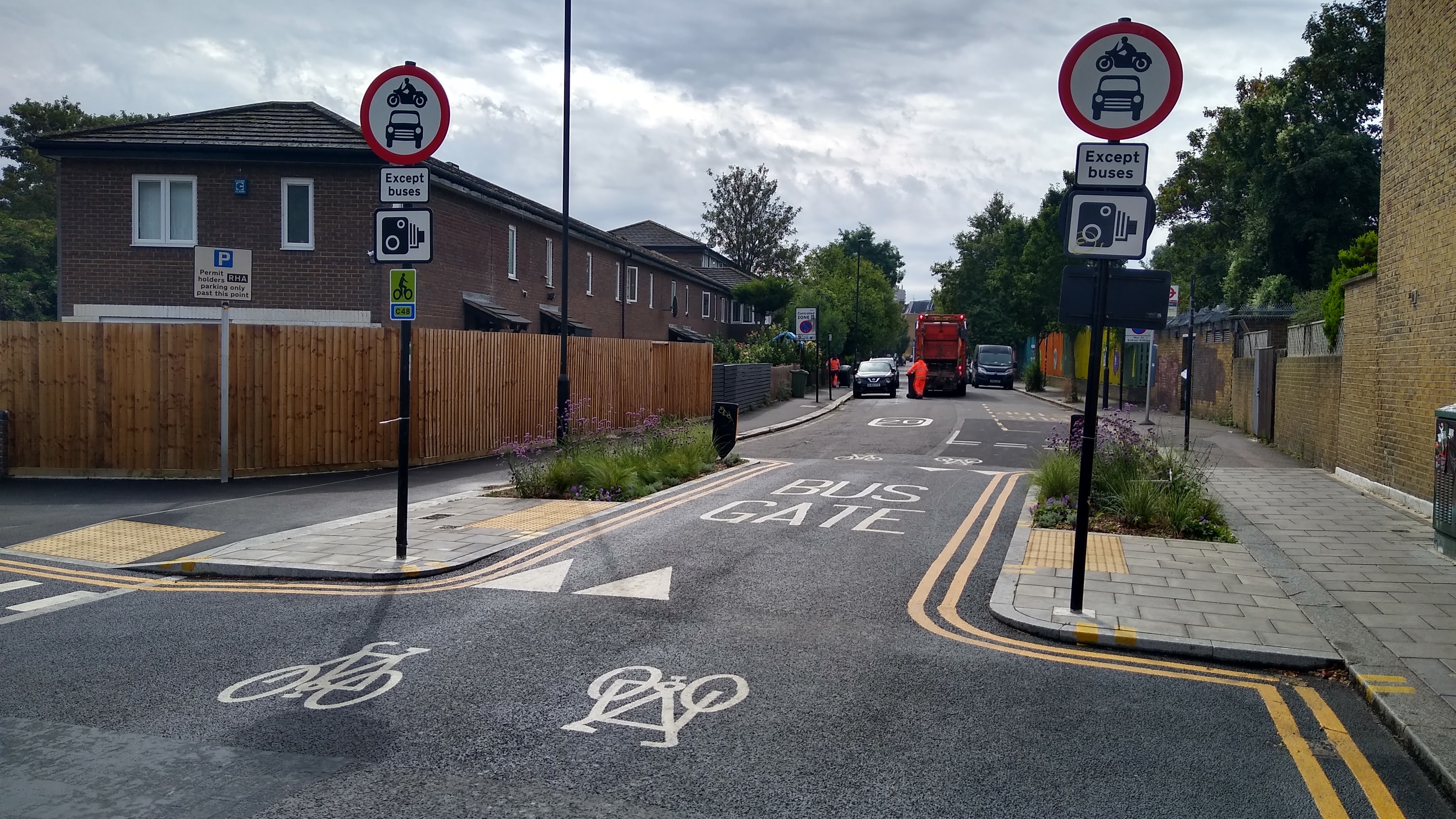
Road traffic and highway law continued to evolve with The Traffic Signs (Size, Colour and Type) Regulations 1950 updating the 1933 regulations, but it wasn’t until The Traffic Signs Regulations and General Directions 1964 that we saw a whole book of traffic signs and road markings that we’d find familiar today, including the “no motor vehicles” sign (above) that so many drivers claim not to understand after 60 years of use.
The Traffic Signs Regulations & General Directions 2015 is the current Big Book Of Traffic Signs which is some 419 pages of A4 text long, should you wish to read it in print, and the vast majority of traffic signs and road markings it covers are there to manage motor traffic, where it goes and where is stops, as well as warning and inform drivers. There are of course things in there which are solely aimed at walking, wheeling and cycling; but when you really think about it, not that much is covered because people walking, wheeling and cycling generally don’t need much management where there is no motor traffic. Because it is complex, there is also several chapters of the Traffic Signs Manual to help with the design and layout of traffic signs and again, most of it exists because of motor vehicles.
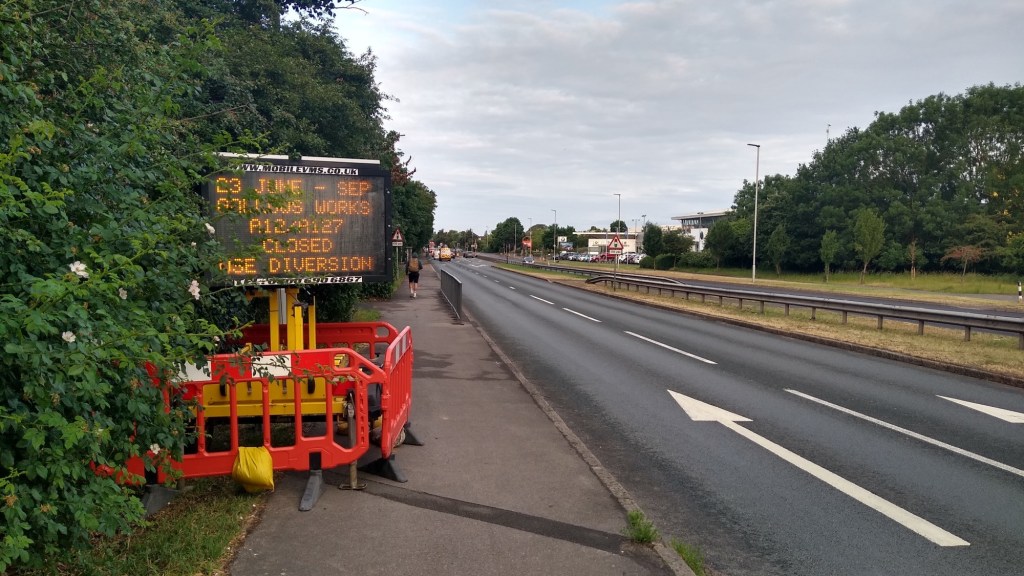
Then we have street works. A whole subculture of special traffic signs, cones and sometimes road markings which exist partly to manage motor traffic and partly (and importantly) to protect road workers from harm, as well as stopping highway users themselves coming to harm. People walking, wheeling and cycling need to be kept out of worksites, but in undertaking works, space is often taken from motor traffic and in turn, managing that loss of space all too often impinges on those not in motor vehicles. Whether it is closing cycle lanes, requiring people to cross the road to avoid a blocked footway or the usual practice of plonking signs on the footway (above), the spirt of the Code of Practice must live in a different realm for many temporary traffic management designers.
Whilst we are talking about street works, most of the work being undertaken is to install and maintain utilities which are a foundation of modern life. Utilities are laid at various depths and while we cannot pin this wholly on the existence of motor traffic, its loading does have some influence on depths under carriageways which in turn make it harder to get at and so we’re back to all of that temporary motoring infrastructure! We can’t forget about carriageway maintenance of course, and while the structural impact on structural pavements comes from HGVs, there’s still surface wear and tear to consider.
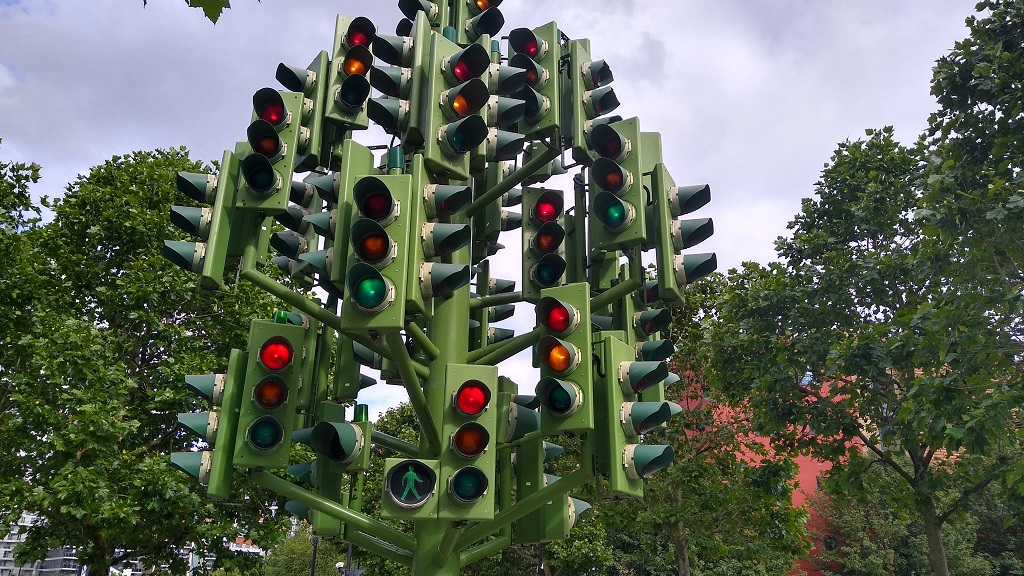
Traffic signals are a classic. They are not safety devices, they are (motor) traffic management devices which exist to manage completing streams of traffic and to give quieter streets some priority of access to a junction and for pedestrians and cyclists (and occasionally equestrians) a chance at crossing a road or junction. A pedestrian crossing is not pedestrian infrastructure, it is motoring infrastructure that is needed to offset the impact of motor vehicles and off course, we then get into the need for people to press a button to cross which is subservience to drivers and the act of having to push a button can be difficult for some people to manage. We can turn this on its head with “green authority” crossings which level the playing field a bit. In fact, in the Netherlands, traffic signals are being removed when motor traffic has been heavily reduced.
One could even go as far and describing as the dropped kerbs at crossings and junctions being motoring infrastructure. Again, maybe not fully, given that raised sidewalks were a pre-motorisation way of keeping people out the filth on the streets or safe from errant carts, but we can design streets without kerbs where we don’t need to provide protection from motors, although trying to stuff lots of motor vehicles through streets with level surfaces isn’t exactly an inclusive outcome for some people, although level surfaces can help others and that is why that street design is challenging. As we’re talking about dropped kerbs (or crossings on speed humps), even blister tactile paving is mostly motoring infrastructure, although we will accept that it’s also needed where cycle tracks are crossed. Dropped kerbs to provide vehicular access to off street parking or premises are also, of course, motoring infrastructure which all to often degrade the walking and wheeling experience.
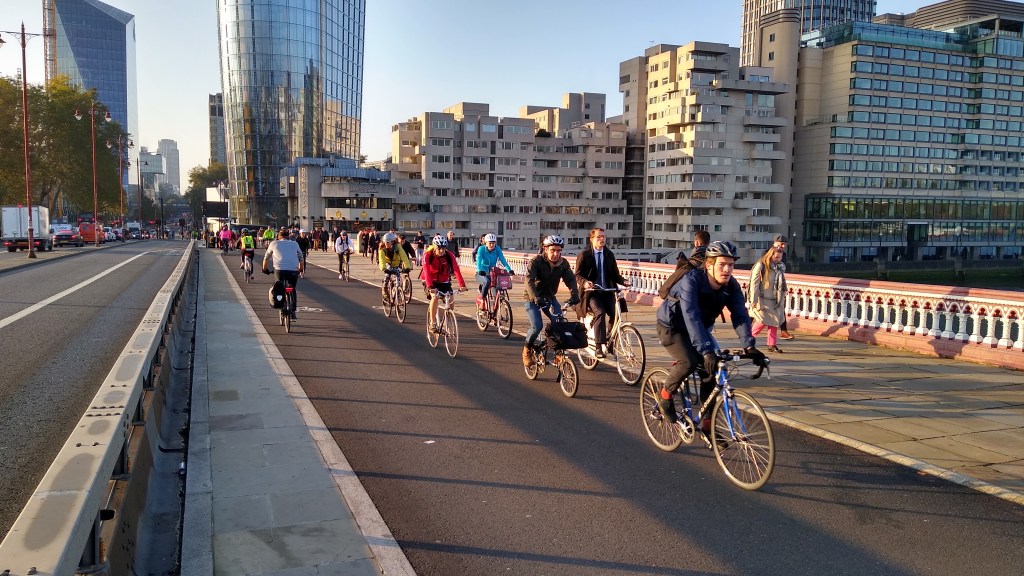
Talking of cycle tracks (and indeed, cycle lanes), these are motoring infrastructure, not cycling infrastructure. Cycle tracks exist to help protect people cycling from motors, but they are also a traffic management tools which help marshal cycle traffic at controlled junctions and in some cases, the efficiency of cycling gets in the way of drivers who need help crossing the streams – case of the system eating itself! Even traffic-free links might be motoring infrastructure where they are provided in preference to tackling more direct on-street links. Cycle lanes, provide scant protection from motor traffic and we’d argue that most of them are used to avoid reallocating meaningful road space, although doing it properly can be complex and costly because of the work needed to recalibrate the space away from that which is managed exclusively for driving along.
There is an interesting piece of Dutch thinking that warns us to be careful that we don’t recreate the problems that motor traffic has caused cities with cycle traffic with it seen as an engineering problem to be solved; although the magnitudes are different. A small example of this might be zebra crossings over cycle tracks where the degree of compliance from people cycling isn’t great, but this stems from us trying to use the motonormitive thinking instilled in the administrative control of a zebra crossing rather than thinking about how people interact in human space at the human scale. It’s tricky.

Not all bridges are motoring infrastructure of course. Sometimes rail and water is being crossed and if the bridge doing the crossing is for walking, wheeling and cycling, then it probably can be called a foot or cycle bridge most of time. But bridges and underpasses crossing roads designed for motor traffic are often badged as being provided for safety, but if we are honest, it’s for traffic flow. Even one of our favourite bridges, Bradford’s Big Red Bridge, might have a surface level crossing under it these days (which is motoring infrastructure), but it still serves a different desire line severed by the main road it crosses.
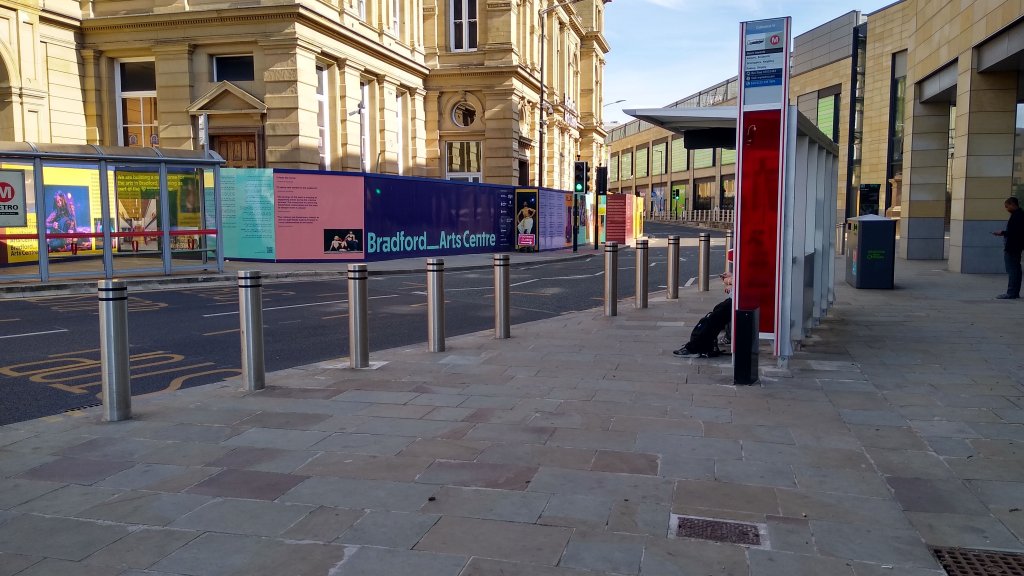
And finally, we have Hostile Vehicle Mitigation (HVM) which is a specialised area of work, but one which arises from the extreme use of motor vehicles. This motoring infrastructure impacts public space on a daily basis, be it aesthetically, or with the impact on people walking, wheeling and cycling next to it and through it where it erodes usable footway space or creates collision risk (for people cycling). The example above is how a bus stop has been impacted in Bradford city centre and where bus accessibility is impacted by the layout.
Motor vehicles are incredibly useful and even from a sustainable mobility perspective they have a place including and beyond buses. However, we think there needs to be much more emphasis and recognition on how the things on our streets are mainly motoring infrastructure and that is our call to action. Reframing our language and appraisal systems means that we shouldn’t be talking about the cost of a cycle track or a crossing, we should be talking about the costs of mitigating motor traffic. We shouldn’t be talking about cycling safety schemes, we should be talking about making cycling safe from traffic schemes. We shouldn’t be talking about pedestrian crossing schemes, we should be talking about giving opportunities to cross back to people. We shouldn’t be talking about speed limits, we should be talking about reducing kinetic energy in a system where all too often it is those not driving who have to live with all the compromise.
 City Infinity