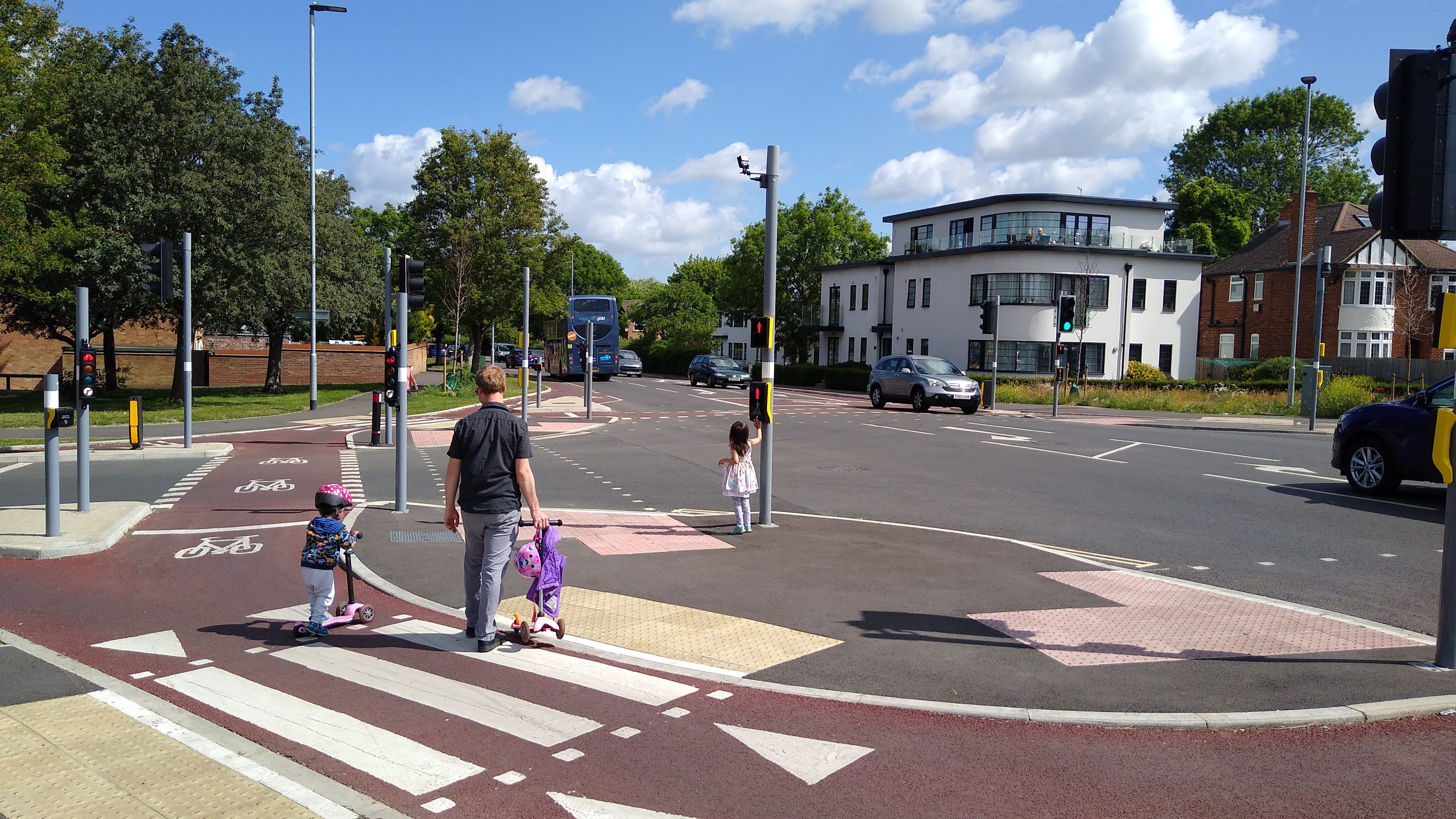
On 26th and 27th March 2025, Mark attended the BCP Council Transport Conference where he gave a talk called “Movement, Space, Choice & Place. You can download his slides from our Community page, but this post is a bit of a narrative that sits behind them.
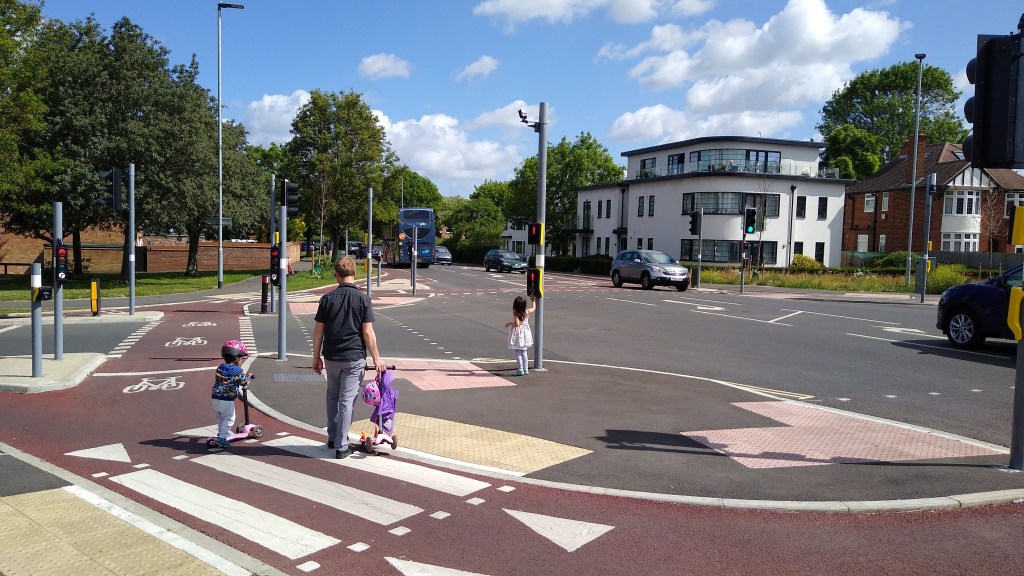
The opening image of Histon Road above was chosen to counter the often advanced commentary that cycling infrastructure is poor for walking and wheeling. In his talk, Mark said that in fact, most of what we see on the streets is motoring infrastructure which is required to manage the use of motor vehicles and the trade-offs all stem from that.
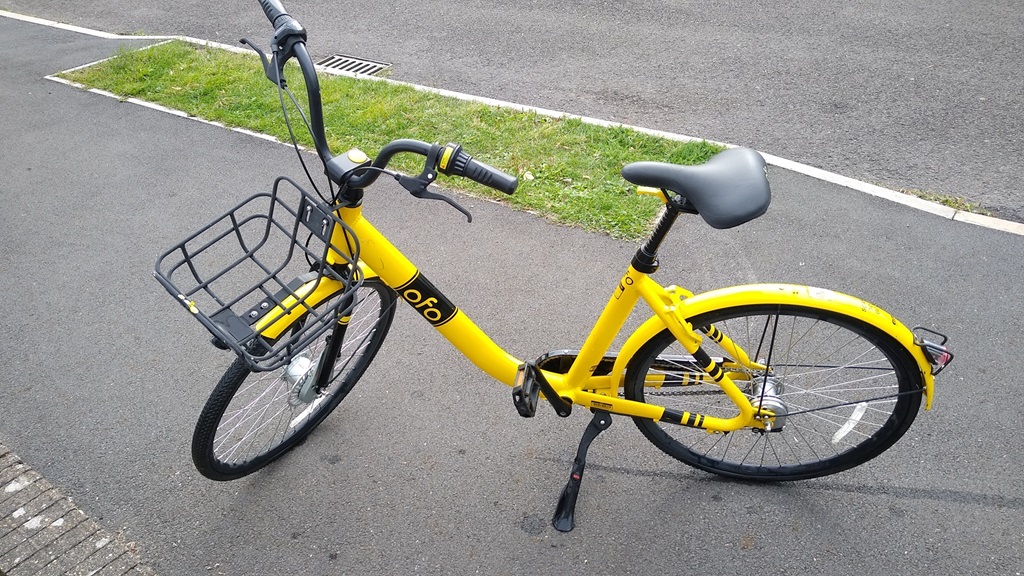
As delegates read who Mark was, he talked about his yellow Ofo bicycle (above) which cost £30 second hand and comes with all of the refinements needed for utility cycling, although he said its saddle tends to gently sink as it’s ridden, something to fix. The image was used to explain that cycling as a transport choice needs decent low cost cycles as ownership is a barrier.
Mark then did a hands up survey on how people had travelled to the conference which probably unsurprisingly had about 50% for driving/ driven with other modes taking the other 50% to varying degrees. He then asked how many people had walked and wheeled for part of the their journey which didn’t get everyone raising their hands as many people were still thinking in “main mode”. When Mark explained that even if someone had walked from the nearest car park, they had still walked; and he then drew the parallel with travel data often concentrating on main mode for commuting which excludes so much else. He said it was a serious issue if we are making decisions on such narrow data.
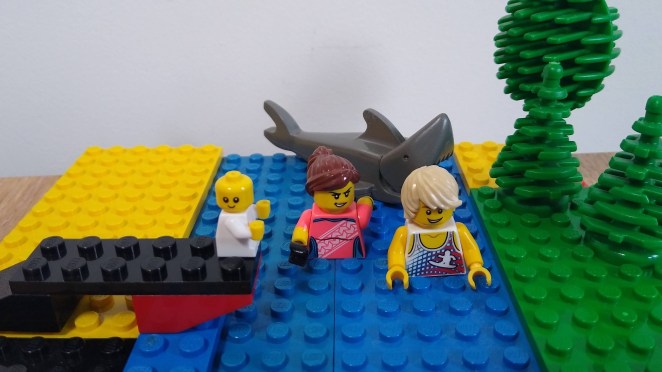
Brent Toderian.
The Lego scene above was a slide featuring one of Canadian urban planner, Brent Toderian’s quotes. Mark said that as well as making sure we collect a wider set of data about trips and purpose, we also need to be alive to the fact that we might be missing people who are not travelling for many reasons, including the hostility of streets and so we need to be working harder to find those people.
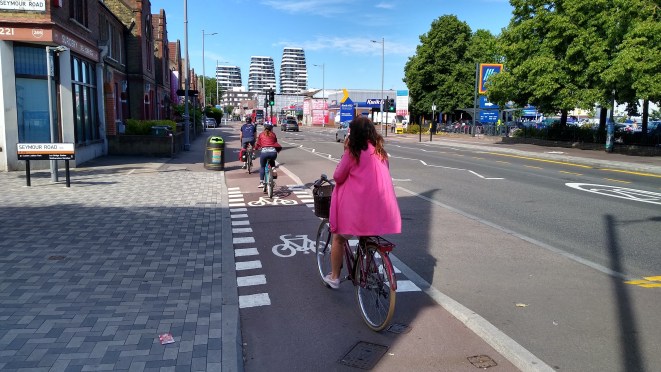
Mark then got into the detail of the “Movement” theme of his talk. Lea Bridge Road (above) was a point of reference as he explained that people want and need to travel for work, school, shopping, leisure and to visit family and friends. The street can provide people with a range of choices based on the trip they are making, their preferences and any number of issues at the time of travel; but choice is key.
Mark then used some local mapping and data to show that the BCP motoring network was very well established to provide almost door to door access, whereas the walking network had issues of quality and the cycling network was patchy and often disjointed. He showed that during Covid, lots of people started cycling as driving dropped, but as driving increased again, cycling decreased. Mark said people want protection or quiet streets which seems obvious and is supported by data, but which needs constant repeating.
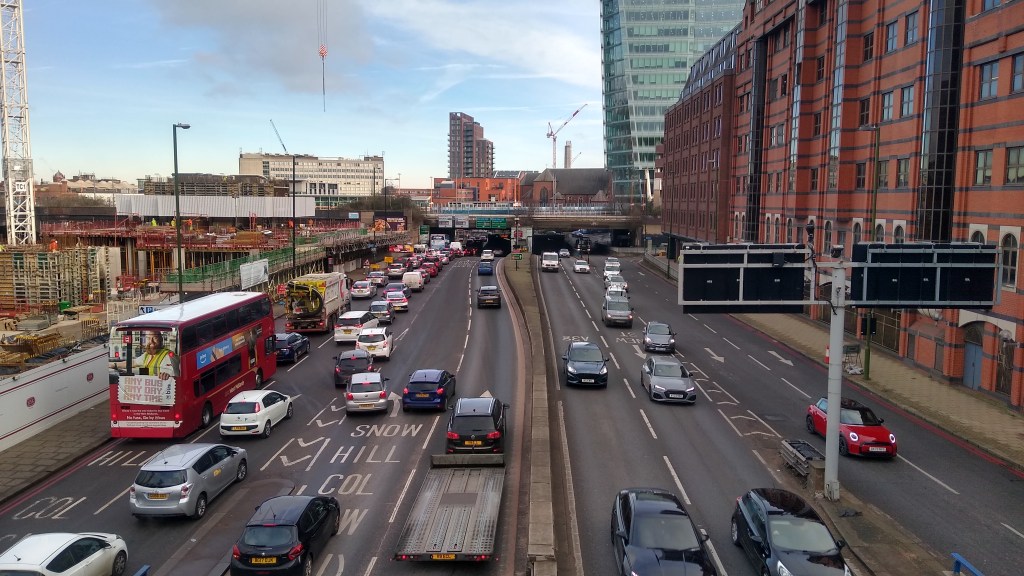
Mark used the photograph above to state that “doing nothing is not an option”. He said that from the traffic growth data previously shown, we are hitting the geometric problem of not having enough space to keep accommodating cars, especially as we’re not creating new land in cities! Mark’s point was beyond the environmental and climate change considerations, it was a basic matter of space and he cited Birmingham City Council’s “City Centre Movement & Access Strategy” as a programme to rebalance the use of space to give people more transport options.

Getting into the “Space” discussion, Mark used the 20 metre wide Middenweg to show how walking, cycling, kerbside, driven and public transport have been accommodated to allow people to live and shop in the area. He said that this had not been done in isolation as it has taken network-level work to control motor traffic flows to enable mixing with trams on what is a key arterial road from the A10 motorway to the south, to the city’s ring road.
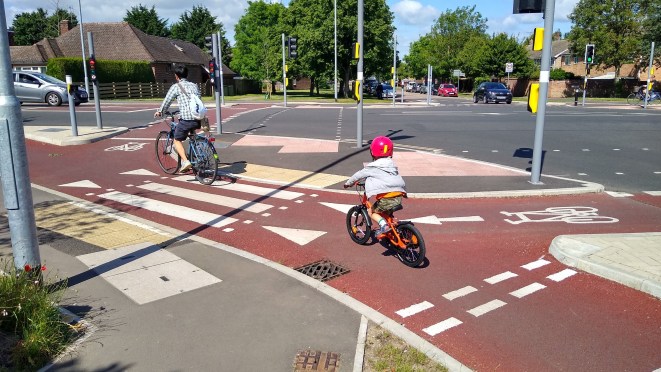
In another space example, Mark looked at Histon Road in more detail and explained that it was another movement arterial which connected the A14 to the north and the city centre, but provided clear space for each mode along with safer junctions in a way that provided balance to all road users and which, again, gave people choices.
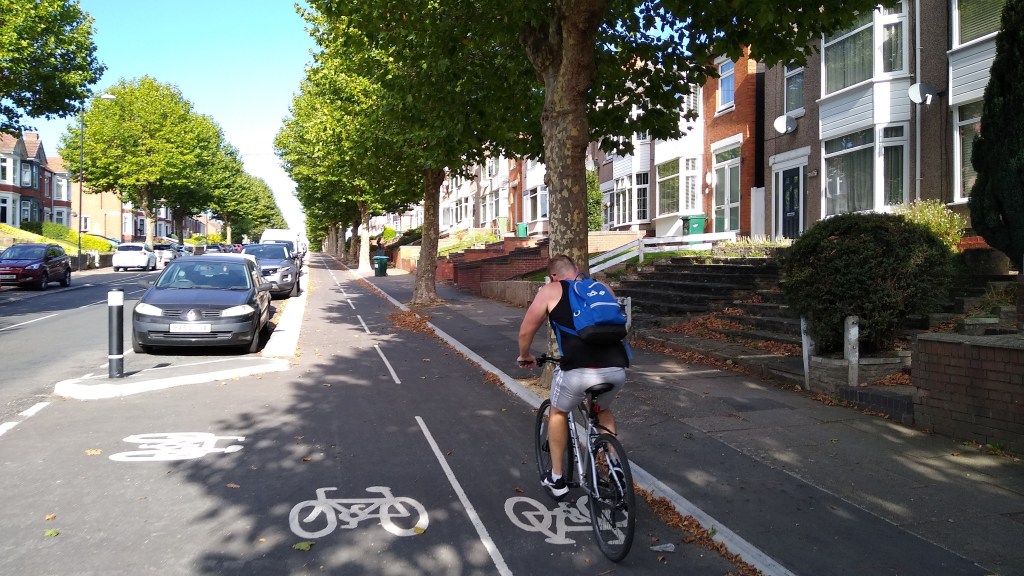
Moving into the “Choice” theme, Mark showed the Coundon Cycleway which connects a suburb of Coventry to the City Centre. He said that again, this demonstrates that people have a choice to walk, cycle and use buses and even if they need to use a car, the design manages to retain car parking space for those needing or wanting it.
Mark then showed some slides which showed that people walking and cycling spend the most on the high street and especially walking – the “Pedestrian Pound” and why wouldn’t businesses want to embrace walking as a key mode? He finished the theme with a still from the #BikeIsBest campaign video of a man about to put a single pint of milk into the back of his truck. He said that people are of course free to use a truck to buy milk, but that shouldn’t be at the expense of people walking, wheeling and cycling to their local shops.
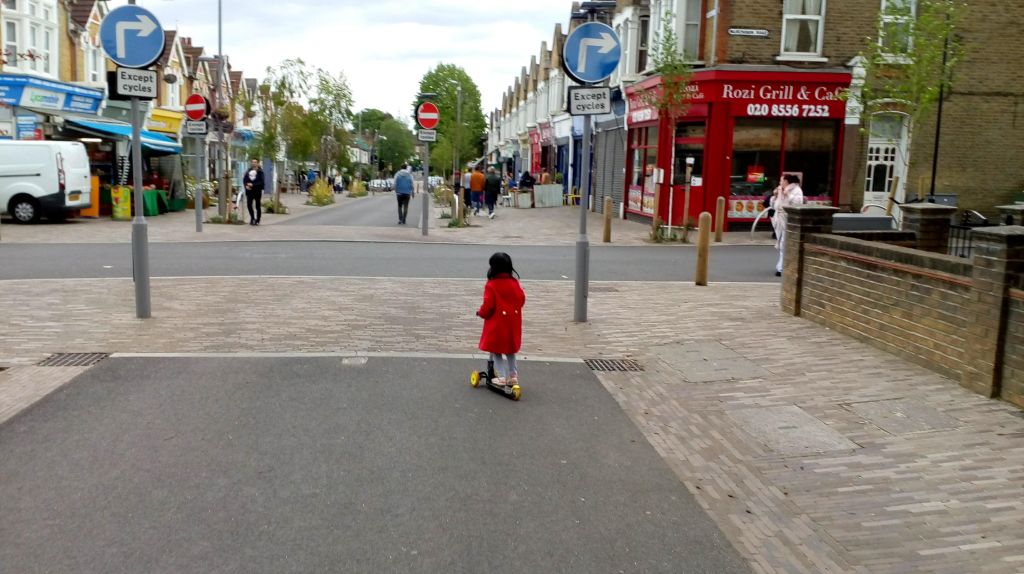
Finally, it was back to Waltham Forest to talk about “Place”. Mark conducted another hands-up survey on which street people liked. He flashed two images up pretty quicky, because in fact, both were of the same spot on Francis Road. People clearly preferred the image of the street following it being reimaged with part time pedestrianisation, two-way cycling, out of hours loading, car parking and daytime loading on the edges and somewhere which was peaceful, pleasant, supported local businesses, enabled children to be themselves and which was at the heart of the community. Compared with the “before” of narrow footways, footway parking and congestion, it wasn’t a hard choice!
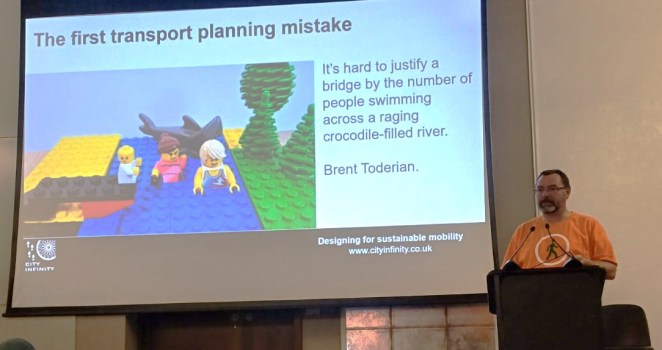
For his talks, Mark wore very bright T-shirts, orange the first day, green the second. Both featured a stylised “green man” crossing logo with the words “Human Traffic”. While this is inspired by the 1999 film “Human Traffic” it served as a reminder that in transport planning and engineering matters, our traffic is actually human traffic and we should remember this in our work. It’s also a little reminder about getting out of comfort zones because Mark did stand out quite a bit!
 City Infinity