Engineers don’t talk about their projects enough and so in the first of an irregular series of posts, we want to bring you some little stories about what we have been working on. OK, it’s a bit about promoting our offer, but hopefully we can inspire you along the way too.
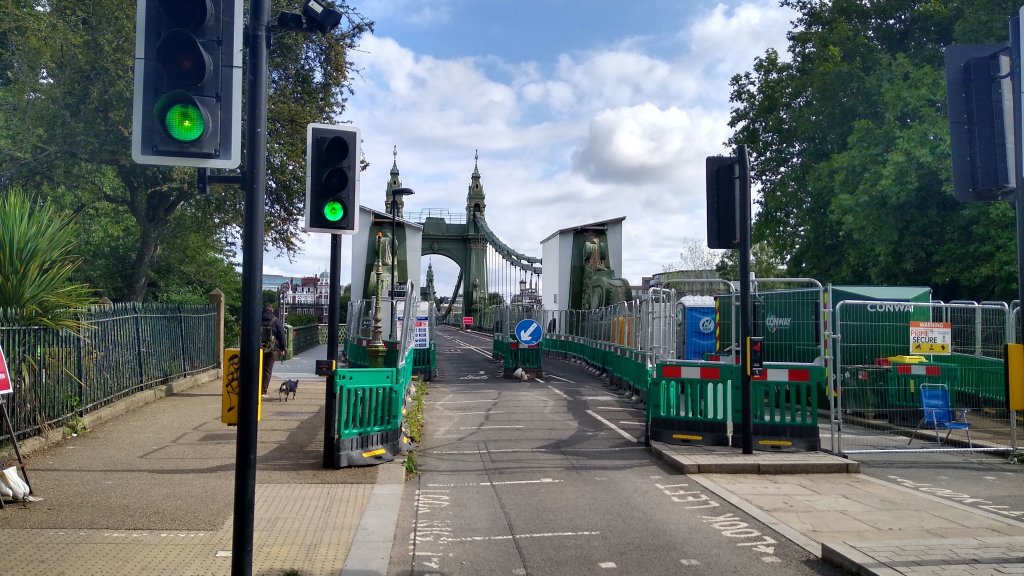
The problem with old bridges is they rarely age like a fine wine, and they become increasingly awkward and costly to maintain, especially where they are unique in form and historic in nature. Few people seemed to be thinking about a “do minimum” option which would maintain the new no motor traffic business as usual of the past few years which very much belies the motonormative thinking our society automatically applies to the highway network.
The charity Possible was thinking about the do minimum, but they wanted to explore a way of providing a public transport link over the bridge given the bus service was rerouted when it closed, and which left a large public transport gap for the people south of the River Thames. Possible had a plan, but they needed some technical support to scope out some of the highways issues and develop the concept a little more. We came into the project when Leo Murray of Possible and our founder Mark Philpotts chatted through the idea.

The brief was essentially to develop a proposal which added a way of running lightweight autonomous pods across the bridge to provide links to bus services both sides of the Thames along with improvements to walking, wheeling and cycling across the bridge and its approaches. The general weight restriction on the bridge meant only the smallest pods could be carried and then only one at a time. In order to assist and simplify the pods’ navigation systems, guide kerblines would be required – also known as a “podway”, a term that Mark claims coining in March 2022!
As is usually the case, there wasn’t unlimited highway width and so the podway would have to operate on a shuttle basis. So there could be some level of headway between the vehicles, passing places would be needed as well as podway stations where passengers would interchange with buses with no more than a 100 metre walk. But this was not a purely public transport offer. The plan needed to provide better conditions for people cycling, but this couldn’t come at the expense of walking and wheeling space.

The space on the bridge lent itself to maintaining the existing footways and then having half the carriageway for the podway and the other half for a two-way cycle track (above) which would improve what is now Cycleway 57. On the north side of the bridge, the podway ends at a small station adjacent to a bus interchange, and the cycle track is routed towards Bridge View which in turn connects to Cycleway 9 on King Street to the north of the A4 via an existing cycle route.

To the south of the bridge, cycle traffic rejoins the carriageway at Castelnau, but traffic volumes would be very low here, so mixing with motor traffic would be acceptable. The space allows a decent buffer between the podway and the carriageway which is used for a passing place for pods as well as loading space, a taxi rank, a London cycle hire dock as well as verge space that could be utilised for sustainable drainage.

Finally, Castelnau meets the Londsale Road junction which was developed to be large enough for buses to U-turn within and under signal control. This is quite an unusual approach, but as with most things in highways, it has been done before – have a look at this U-turn facility for buses on Waterloo Road in London.
The story didn’t end there. Possible was eager to really push the idea to its limits and so the northern podway station was relocated near Hammersmith Station with the podway extended further. This was pretty complex to get to work, but eventually it all fitted together and it supported Possible’s bold plan to imagine a different future for the bridge. Our drawings formed the reference base to some amazing visualisations and a project fly-through.
The design development threw up some other challenges which still need to be resolution such as legislative changes which would enable the podway to be constructed and operated within the highway, as well as approvals for some of the traffic signals which would be needed where traffic (of all classes) crossed with the podway.
Nobody really knows what is going to happen next with the bridge because it hinges on whether level of investment for a full reopening will be made available somehow (and there are options). However, this project is a great reminder that we should also dare ask the alternative questions because the future isn’t set in stone.
We imagine streets, neighbourhoods, towns and cities where walking, wheeling and cycling are the safest, easiest and most natural choices for local trips. We design for sustainable mobility and can help you to create better places – take a look at our website for the services we offer.
 City Infinity